How to spot a restocked stall before you pay
A market can hold two kinds of selling in the same aisle. One serves the neighborhood. The other restocks trays that look almost the same from town to town. Learning to tell them apart is less about suspicion and more about slowing down long enough to see what repeats.
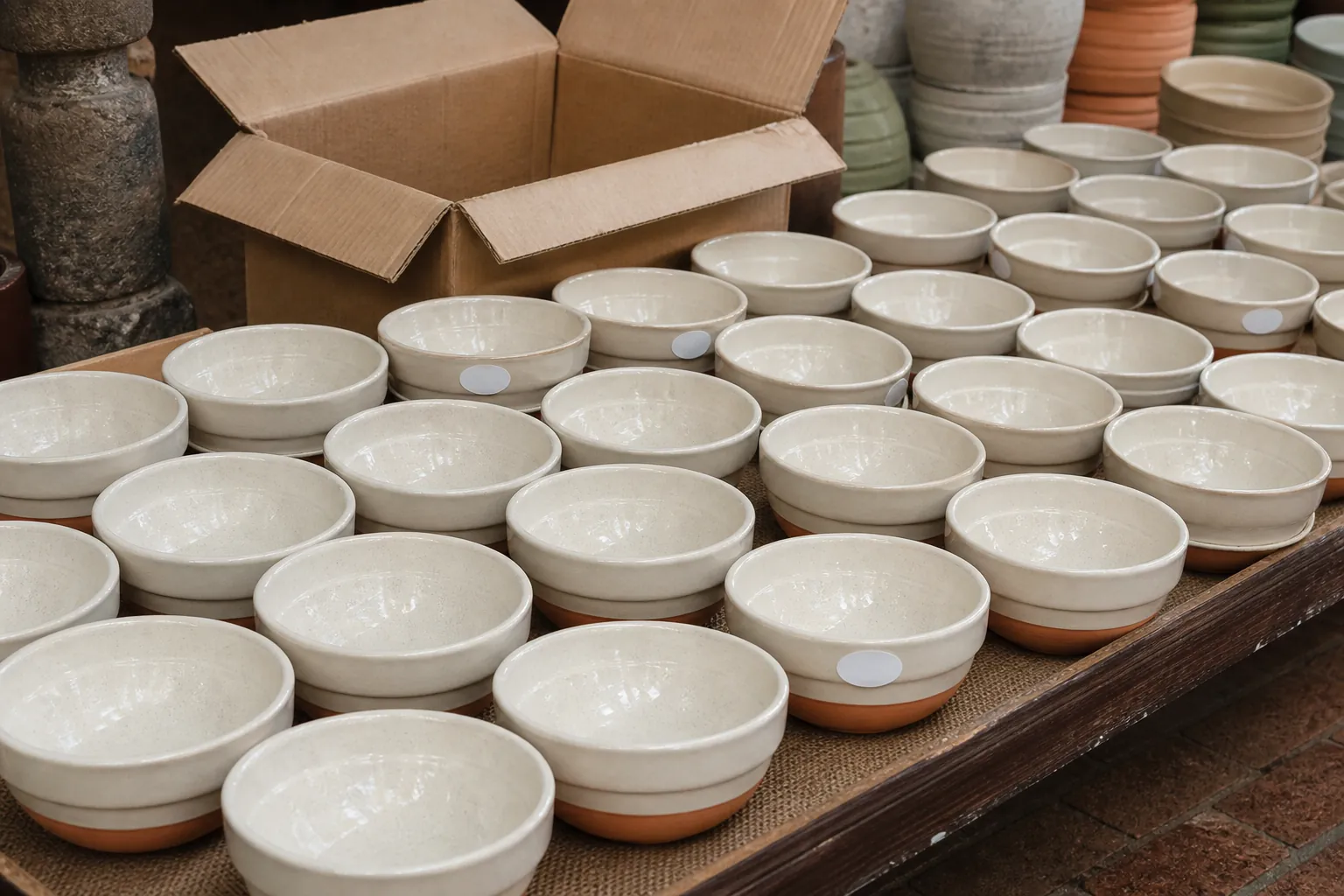
Most travelers do not set out to buy restocked goods. They set out to bring home something that feels connected to the place they are walking through. The difficulty is that visitor trays are designed to look like that connection. Cloth is folded the same way. Bowls sit in neat ranks. A printed label suggests a workshop that may not exist on the next street. None of this is a crime. It is simply a different kind of trade from the household row that sells soap, string, greens, and tools people use every week.
On a first circuit I walk without buying. I watch who stops where. Regulars tend to move with a list in their heads. Visitors tend to linger where photographs would be easy. That difference alone is not proof of anything, but it marks the places where I should look harder before money changes hands.
Start with what repeats
Restocked stalls often reveal themselves through sameness. Turn a bowl over and look at the foot ring. If twenty pieces share the same glaze fault in the same place, you are looking at a production run, not a week of work from a small kiln. Identical stitching errors on a stack of bags tell a similar story. So do hanging tags that still show carton creases, or goods that smell of plastic wrap rather than of the material they claim to be.
Local work is not always rough, and factory work is not always neat. The tell is the pattern of mistakes. Handmade pieces tend to vary. Restocked trays tend to fail in chorus. When variation disappears, ask why.
If the only difference between this stall and the last town’s stall is the awning color, you are no longer reading a place. You are reading a supply route.
Watch the back of the stall
What sits behind the display often matters more than what sits in front of it. Sealed cartons with printed barcodes, shrink-wrapped multipacks, and stacks of the same object still nested in transit foam are quiet signals. A workshop that finishes pieces nearby usually has unfinished work in view: drying racks, spare handles, cloth scraps, a knife with clay on it. A restocked stall often has only the finished product and the box it arrived in.
Light changes through a morning. A stall that looked local at dawn can receive a van delivery by noon. That is why a single walk is not enough for a strong claim. It is enough, though, to decide whether you should ask a few direct questions before you pay.
Questions that gather facts, not confessions
You do not need to cross-examine anyone. You need information that changes a purchase decision. Useful questions are concrete:
- Was this made here this week, or did it arrive already finished?
- Who made it — you, a neighbor workshop, or a distributor?
- What is it made from, and can it get wet?
- Do you sell the same pieces in other markets along this route?
The answer may be vague. That is still data. A seller who can describe the making process in specific steps is different from a seller who points only at a label. Neither answer makes a person good or bad. One answer helps you understand what you are carrying home.
Compare household rows with visitor trays
Household rows show quantities that make sense for daily life: soap in ordinary sizes, greens in bunches people actually cook, hardware meant to repair rather than to decorate. Visitor trays show objects sized for a suitcase and arranged for a photograph. When those two worlds sit side by side, walk both. The contrast trains your eye faster than any list of tips.
I also look at how goods are priced relative to each other inside the same market, without treating the number as a trophy. If a tray of identical souvenirs sits beside repair tools and cooking staples, the social use of each row is already different. Buy from the row whose use you can explain once you are home.
- Repeating labels across many stalls in one square
- Identical glaze or print faults in a whole tray
- Sealed cartons still open behind the counter
- Objects that match trays you have already seen on this trip
- No unfinished work, tools, or materials in view
What to do once you see the pattern
Seeing a restocked stall does not require a speech. You can thank the seller and keep walking. You can also buy something from it if the object has a clear job in your house and will travel well. The point of these checks is not purity. The point is not confusing a supply chain with a place.
If you came for a reminder of where you walked, look for materials, tools, and food that belong to that square’s ordinary week. If you came for a gift with a use, name the use before you enter the aisle. Either way, the restocked tray stops being a trap once you can recognize it as one option among others rather than as the whole market.
Markets change between visits. A workshop may sell through a neighbor for a season and then stop. A distributor may arrive with better-looking labels. Treat every note, including this one, as a method rather than as a permanent map. On the day, your eyes and a few calm questions still do the real work.